No Fee Unless We Win
Every case is on contingency. The consultation is free, we advance the case costs, and our fee comes only out of the recovery.
Serving Riverside, CA — the county seat
Hurt in the 91/60/215 weave, on the 91 commute toward Orange County, or on Magnolia? Get a local attorney on your side before the insurance company calls. No fees unless we win.
Available 24/7 · Se habla español · Free consultation
Tell us about your crash. An attorney responds fast — usually within minutes.
Every case is on contingency. The consultation is free, we advance the case costs, and our fee comes only out of the recovery.
Injury cases from this city are typically heard at the Hall of Justice downtown — not a satellite docket in another county. We already work this venue.
The 91 west toward Orange County, the 91/60/215 interchange, Magnolia, University Avenue to UCR — different roads, different evidence.
Riverside is the county seat, not a suburb that borrows a courthouse. The 91/60/215 interchange is how a huge share of this city moves; the 91 west is how a huge share of it earns a living in Orange County; Magnolia Avenue is the historic spine; University Avenue is the downtown–UCR couplet. If you've been searching for a car accident attorney near me from a Riverside Community Hospital waiting room, this page is for you — Riverside, California, not another city that shares the name.
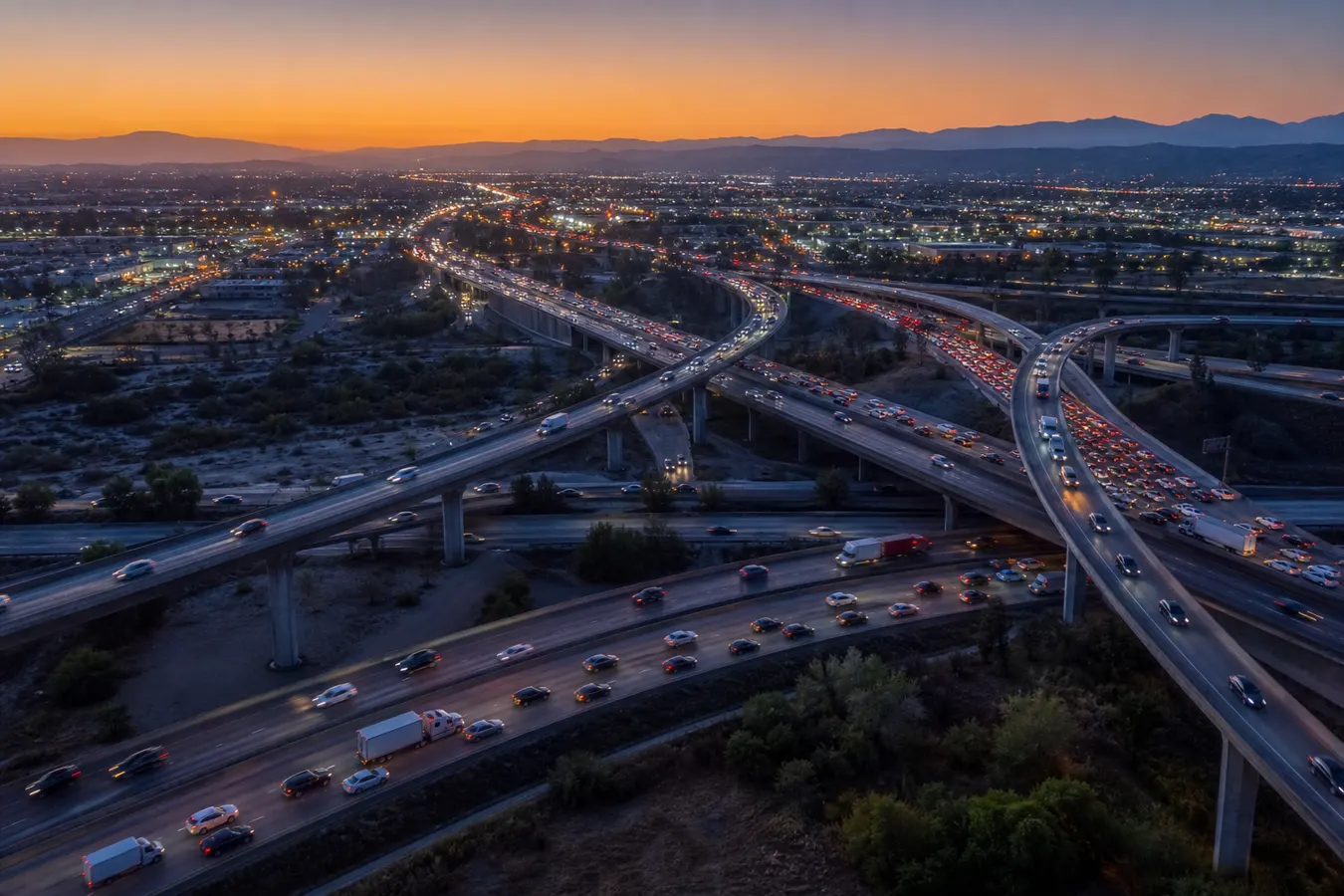
Three freeways share one junction on the north-central side of the city. Short weaves and lane drops produce disputed lane-change stories and multi-car chains. Early evidence — the CHP collision report, event data recorders, nearby cameras — is what separates a strong file from a stalemate. Footage overwrites in days.
City streets usually mean Riverside Police; the freeways mean CHP. Treatment is typically Riverside Community Hospital (Level I trauma), Parkview on the west side, or Kaiser Riverside — RUHS in Moreno Valley is near the city, not in it. Cases are typically heard at the Riverside County Superior Court downtown. That is the home-field fact LA and OC tower firms treat as a drive.
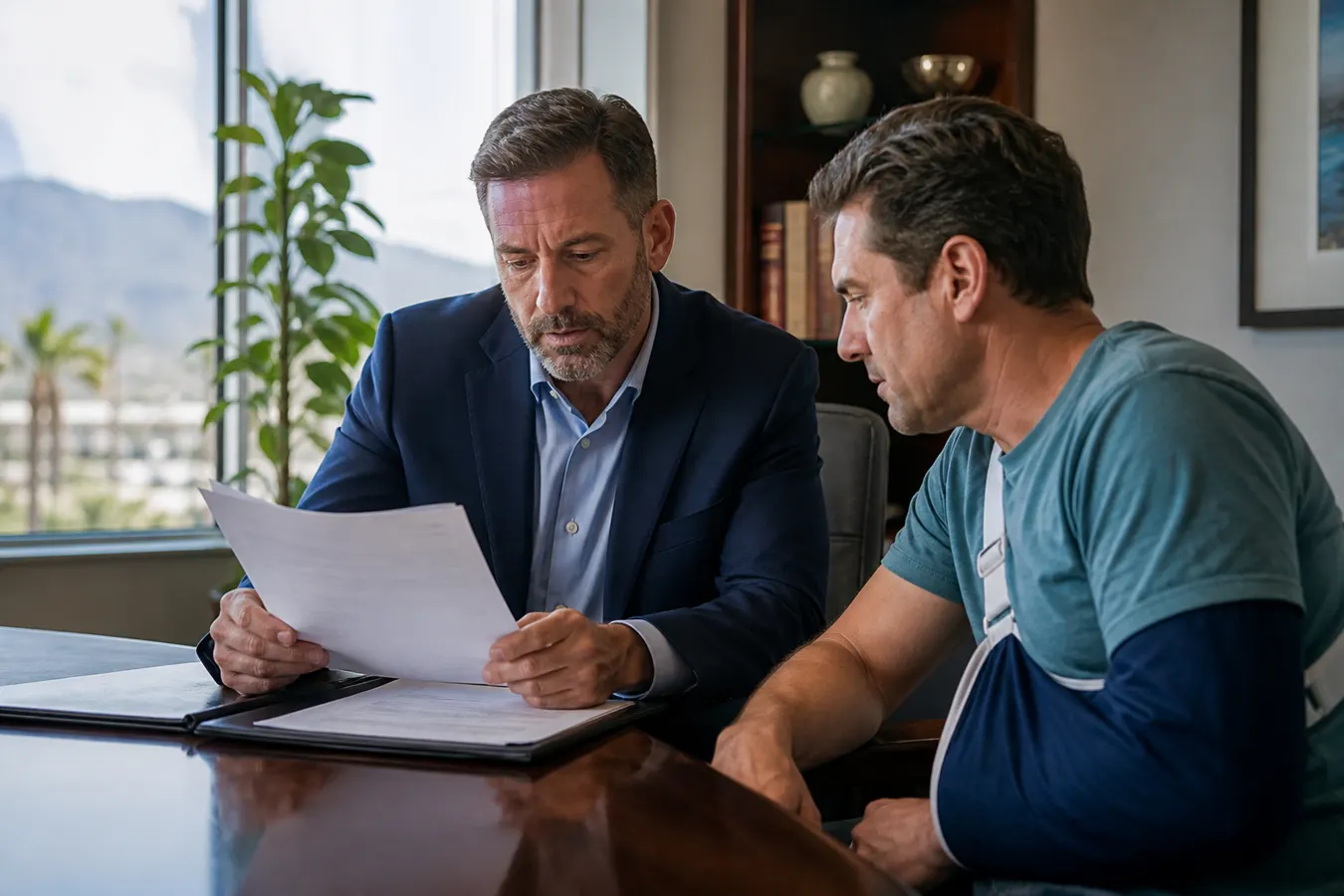
Get medical care first, even if you feel “mostly fine.” Photograph everything, get the report number, file the SR-1 with the DMV within 10 days when anyone is injured, and give the other driver's insurer nothing recorded. California allows two years for most injury claims — six months if a public entity is involved — but call within 30 days of your accident. The strongest files are built in the first month.
This is the long version — every deadline, agency, corridor, and dollar figure that shapes a Riverside injury claim, written for the city where the county's cases actually get decided. Reading it takes about 12 minutes. Skipping it takes one call: (909) 233-7999, answered 24/7, free.
Injuries first: call 911 and accept transport if you're hurt — refusing the ambulance to tough it out is the first line every adjuster looks for. If you can move safely, work the scene: photograph all 4 corners of each vehicle, the other driver's license, insurance card, and plate, the lane positions before anyone moves, and the nearest cross-street sign. Collect witness names and numbers on the spot; on a commuter corridor like the 91, witnesses are gone in 5 minutes. Get the report number from the officer before they leave.
Then the paperwork nobody mentions: California requires an SR-1 filed with the DMV within 10 days for any crash with injury, death, or over $1,000 in damage — a threshold nearly every modern repair bill clears. Skipping it risks license suspension even when the crash wasn't your fault. See a doctor within 72 hours regardless of how you feel; adrenaline hides soft-tissue and head injuries for 1 to 3 days, and the medical record you create this week is the spine of the claim.
Riverside runs its own police department, which changes the report logistics. Surface-street crashes inside city limits go to the Riverside Police Department — records requests run through RPD downtown. Crashes on the 91, the 60, the 215, or any ramp belong to the California Highway Patrol, requested with a CHP 190 form from the Riverside area office. Get the agency wrong and you'll wait weeks for a report that was never coming.
Reports usually surface in 1 to 2 weeks — longer with major injuries or a DUI hold. As an involved party you're entitled to a copy, and it matters more than people expect: it fixes the officer's fault read, both insurance policies, and witness contacts in one document. Errors can be challenged with a supplemental statement, but only if you catch them early. A law firm pulls the report for you as a matter of routine — one call to (909) 233-7999 sets that in motion the same day.
Start where 3 freeways meet: the 91/60/215 junction moves a staggering share of Inland Empire traffic through short weaves and lane drops, and the 60/215 split by Box Springs adds grade and speed to the mix. The 91 west toward Orange County is one of Southern California's most congested commutes, which means rear-end chains at the Adams, Madison, and Central interchanges. On the surface grid, the pattern is just as predictable: University Avenue between downtown and UCR, Magnolia Avenue's miles of driveways and signals, Van Buren Boulevard's long high-speed stretches, Arlington Avenue, and the retail knot around Tyler Street and the Galleria.
None of this is guesswork — reported injury collisions for every one of these corridors are mapped street-by-street in UC Berkeley's Transportation Injury Mapping System, and the Office of Traffic Safety ranks California cities by crash type. Location also decides jurisdiction: which agency holds your report, and whether a public entity shares fault for the road itself.
Three separate clocks. The main one: Code of Civil Procedure § 335.1 gives you 2 years from the crash date to file a personal injury lawsuit — in this city, at a courthouse a few blocks from where many of these crashes happen. Property damage gets 3 years. The short fuse: if a government entity is in the picture — a city vehicle, an RTA bus, a county unit, or a dangerous road condition maintained by Caltrans or the City of Riverside — Government Code § 911.2 demands a claim within 6 months.
Deadlines are the floor, not the plan. Skid marks weather away in days, businesses overwrite camera loops in 30 to 90 days, and vehicles get repaired or scrapped with their event-data recorders inside. Every week of delay is evidence the insurer never has to argue about. Filing at month 20 is legal; building the case in week 1 is how it gets won.
The strongest files stack independent proof: the police report's diagram and fault finding; scene photos with lane markings and debris fields; the vehicles' event data recorders, which log speed, braking, and steering in the seconds before impact; intersection and business cameras along corridors like Magnolia and University; commercial telematics and dashcams in truck and rideshare cases; and witness statements taken before memories drift. Medical evidence carries the damages side — ER records, imaging, treatment notes, and the paper trail connecting every symptom to the crash.
Two facts about evidence surprise people. First, most of it is perishable: camera systems overwrite themselves and EDR data dies with the vehicle, which is why preservation letters go out the week a firm is hired. Second, the insurer is collecting too — your recorded words, your social media, gaps in your treatment. A case is won by the side that treats evidence as a race, and the race starts at the scene, not at the courthouse.
By percentage, not verdict-or-nothing. California has followed pure comparative negligence since the Supreme Court's Li v. Yellow Cab decision in 1975: your recovery is reduced by your share of fault but never wiped out. Damages of $100,000 with 25% fault still pay $75,000, and even a driver 90% responsible can recover the remaining 10%. That single rule is why it was partly my fault should never end with you hanging up the phone.
It's also why fault is fought, not announced. An adjuster's percentage is an opening bid built to shrink the payout — every point moved is a point they keep. The counter is evidence: the report, the physics of the vehicle damage, EDR data, camera angles, witness accounts. Never guess, estimate your speed, or apologize at the scene; those become the insurer's exhibit A. State the facts, let the investigation set the percentages, and make them prove every point they assign you.
Any number quoted before your treatment is understood is a guess — but the components are always the same: medical bills past and future, lost wages and diminished earning capacity, out-of-pocket costs, vehicle damage, and non-economic damages for the pain, lost sleep, and lost pieces of ordinary life. California puts no cap on non-economic damages in a standard car accident case, which is why documentation of how the injury actually changed your days matters as much as the bills.
The multipliers that move value: injury severity and permanence, the quality of your medical paper trail, the final fault split, and — the one nobody sees coming — the insurance actually available. A serious claim against a minimum-limits driver can be worth several times the policy, which makes your own underinsured motorist coverage the difference between a number that heals and one that insults. The first offers, usually landing within 2 weeks, are priced before your diagnosis is complete. Treat them as the insurer's floor, never your ceiling.
Not the at-fault insurer — not yet. They pay once, at the end, in a single settlement. Until then the sequence runs: your health insurance (reimbursed later from the settlement, usually at a negotiated discount); Med-Pay coverage on your own auto policy if you carry it — typically $1,000 to $10,000, paid regardless of fault; and treatment on a lien when neither applies, with providers agreeing to be paid from the recovery.
Riverside's serious crashes are typically treated at Riverside Community Hospital downtown, Kaiser Permanente Riverside, or Riverside University Health System Medical Center across the Moreno Valley line. Wherever you land, keep everything: bills, explanation-of-benefits forms, prescription receipts, mileage to appointments — each is a line in the demand package. And keep your appointments. A treatment gap is the single most-used justification for discounting an injury claim, because the adjuster reads it as healed, never as busy.
The practical answer, start to finish — this is what you're hiring when you call (909) 233-7999:
You heal; the file moves. Expect real updates at every stage change — report in hand, treatment complete, demand out, offer in — and a direct answer any time you ask where things stand. That cadence isn't a courtesy; it's the job.
Common enough to plan for: the Insurance Research Council has estimated roughly 1 in 6 California drivers carries no insurance, and the 91's stop-and-go is exactly where hit-and-run drivers vanish into traffic. The claim survives — it just changes address. Uninsured motorist coverage on your own policy stands in for the missing driver, and California treats a hit-and-run as an uninsured-driver claim for UM purposes when there was contact and a prompt police report.
Protect the claim two ways. Report the hit-and-run immediately — the report is what unlocks UM, and paint transfer, debris, and corridor cameras identify more runners than you'd think. Then check your declarations page before assuming anything: UM/UIM and Med-Pay are the two lines that decide these cases, and your insurer cannot raise your rates for a claim you didn't cause. Our hit-and-run and uninsured driver page goes deeper, or one call sorts out your specific coverage in minutes.
If your crash happened on or after January 1, 2025 — yes, in your favor. California doubled its minimum liability limits for the first time since 1967: from 15/30/5 to 30/60/15, meaning at least $30,000 per injured person, $60,000 per crash, and $15,000 for property damage on every legally insured vehicle. The California Department of Insurance publishes the full rules.
The practical effect shows up in mid-range injury cases, where the old $15,000 ceiling was gone before the ER bill printed. But don't overrate it: one surgery still outruns $30,000 easily. That's why the second half of every case evaluation is your own policy — underinsured motorist coverage fills the gap between the at-fault driver's limits and your actual damages, and it's frequently the larger check. Bring your declarations page to the free consultation; it's one page and it regularly rewrites the strategy.
The other driver's insurer? No — and you're not required to. Their call comes fast, often within 48 hours, precisely because early statements are cheap ammunition: you're medicated, injuries are still declaring themselves, and I'm doing okay becomes a quote read back at you in month 6. Decline politely, give the claim number a firm handles it under, and let the evidence speak on the record instead.
Three signatures deserve the same caution. Blanket medical authorizations let the insurer mine your entire history for an old complaint to blame your pain on — provide crash-related records instead. Quick releases end the claim forever the moment you sign, no matter what your MRI shows next month. And early low offers arrive dressed as kindness while functioning as caps. Your own insurer is different — your policy requires cooperation — but even that conversation goes better after you've had advice, which costs nothing.
Zero upfront, zero hourly, zero out of pocket. Riverside car accident cases run on contingency: the fee is a percentage of the recovery — typically 33⅓% pre-suit, up to 40% if litigation becomes necessary — and no recovery means no fee at all. The consultation is free either way: (909) 233-7999, any hour.
The only question that matters is whether representation nets more after the fee, and the insurance industry's own research has answered it repeatedly: represented claimants recover substantially more than unrepresented ones. That's the entire reason adjusters push to settle before you make the call. Add what doesn't show up in the math — the calls handled, liens negotiated down, deadlines tracked, paperwork done while you heal — and for anything beyond a scratched bumper, the free consultation is the highest-yield 20 minutes in the entire process.
Honest ranges: clean-fault claims with finished treatment settle in 3 to 6 months; disputed or serious-injury cases run 6 to 18; the minority that require filing suit stretch 1 to 2 years, moving through a courthouse that happens to be in this city. The pacing item is medical, not legal — settling before maximum medical improvement means settling blind, and a signed settlement can never be reopened for the surgery you didn't know was coming.
The sequence: treatment and documentation, then the demand package, then 30 to 60 days of negotiation, then settlement or suit. Money follows settlement within weeks. Expect updates at each of those gates, and ask for them whenever you want — a case without communication is a case drifting. Distrust speed as a selling point: the fastest possible number and the full value of your claim have never once been the same number. What you control is treatment consistency, organized records, and starting early instead of at month 20 of 24.
Riverside is a walking and riding city in ways drivers forget: the Santa Ana River Trail runs the city's western edge, Mount Rubidoux fills with walkers every morning, UCR pushes thousands of students across University Avenue daily, and downtown's Mission Inn blocks mix tourists with turning traffic. When a car meets any of them, the person without the airbag pays — and then gets blamed.
Know three things. Being outside a crosswalk doesn't kill your claim; comparative negligence splits fault, and drivers owe care everywhere, not just at painted lines. The driver's auto liability covers you as a pedestrian or cyclist — and so can the UM coverage on your own auto policy, even though you weren't in your car. And these cases are reconstruction-heavy — sight lines, speeds, signal phases — so scene photos and fast witness contact matter even more than in car-to-car crashes. Our pedestrian and bicycle injury page covers the specifics, including e-bikes and trail crossings.
The money and the rules. Trucks: the 60 and the 215 carry the Inland Empire's warehouse freight, and commercial carriers answer to federal hours-of-service and maintenance regulations — their insurers put response teams on serious crash scenes within hours, so preservation demands can't wait a single week. Motorcycles: California is the only state with formalized lane splitting, yet rider bias still leaks into fault assessments — countering it with physics and reconstruction is half the case. Rideshare: an Uber or Lyft actively on a trip carries up to $1,000,000 in liability coverage, an entirely different ceiling than the driver's personal policy, with coverage tiers that turn on app status.
The shared thread: the standard car-crash playbook underprices all 3. Our truck accident, motorcycle accident, and rideshare accident pages take each apart, or a free case review identifies which coverage tier your crash actually sits in.
Check the sources, not the marketing. The 2-year deadline: CCP § 335.1 on the Legislature's site. Insurance minimums and complaint channels: the Department of Insurance. The SR-1 duty: the DMV. Freeway reports: the CHP. City-street reports: Riverside PD. Street-level crash data: UC Berkeley TIMS. National research: NHTSA.
And for what the statutes mean with your injuries, your policy, and your intersection — that's the free case review: (909) 233-7999. No fee unless you win, no obligation after the call.
The adjuster who calls after your crash sounds helpful. Their job is to close your claim fast and cheap — a recorded statement you'll regret, and a check that runs out before your treatment does.
One free call levels it. An attorney can tell you what your case may be worth, takes over every conversation with the insurer, and you pay nothing unless your case wins. Don't hand your recovery to the first friendly voice on the phone.
Call (909) 233-7999Five-star experiences from injured Riverside residents.
Rear-ended on the 91 heading home from Orange County. They pulled the CHP report, found a second policy I didn't know existed, and explained every step before I signed anything.
Hit on University Avenue near campus. The other driver blamed a 'sudden stop.' Their evidence work — cameras, the box in the car — is what changed the story.
A left-turner on Magnolia put me in physical therapy for months. They dealt with the adjuster so I didn't have to, and the number was honest from week one.
Truck coming out of Hunter clipped my sedan on Iowa. Multiple companies, lots of finger-pointing. They kept it organized and I could focus on work.
The other driver had no insurance. I thought that was the end. They found UM coverage on my own policy and walked me through it in plain English.
Me atendieron en español desde la primera llamada y me explicaron el proceso en el Palacio de Justicia. Muy agradecido.
T-boned downtown near the courthouse while looking for parking. They knew the grid and which cameras to ask for the same week.
As a nurse at the hospital I know what treatment costs. Their valuation matched reality, not a billboard number.
Straight answers. They told me a fender-bender wasn't worth a claim — so when the real crash happened on Van Buren, they were the only ones I called.
My son was hurt as a passenger in a rideshare after a night downtown. Three insurers. They kept us out of the crossfire.
No recovery, no fee. Find out what your case may be worth — free.
Call (909) 233-7999California allows two years for most injury claims — and as little as six months when a government entity is involved. Practically: call within 30 days of your accident. Interchange and downtown cameras cycle in days.
Hourly rates. Retainers. Bills in the mail. Nothing up front. California car accident attorneys work on contingency — typically 33⅓%–40% of the recovery, agreed in writing before we start. If there's no recovery, there's no fee.
Honest math: after a standard one-third fee, about $16,600 remains before case costs and medical liens. We advance the costs and negotiate the liens down. You see every line before you sign.
If nobody was hurt and it's purely a bumper, settling directly can be fine. The moment there's an injury, the quick check is priced to close your claim before you know what treatment will cost. A free consultation tells you which situation you're in.
Don't apologize, don't guess at speeds, don't say “I'm fine,” and don't give the other driver's insurer a recorded statement. Give facts to your own insurer, symptoms to your doctors.
Legally, any time before the statute runs. Practically, within 30 days — footage gets overwritten and the insurer is building its version from day one.
Very possibly. Industry data shows roughly one in six California drivers is uninsured; your own UM/UIM coverage may pay your claim.
Riverside, California injury cases are typically heard at the Riverside County Superior Court downtown — Hall of Justice. Venue still depends on where the crash happened and where defendants reside or do business.
Get examined within 72 hours even if you feel fine — head and soft-tissue injuries commonly appear 1 to 3 days later, and the early medical record anchors the claim. Photograph the vehicles and scene before repairs, save the report number, file your SR-1 with the DMV inside 10 days, and stay off social media about the crash. A free call to (909) 233-7999 puts the whole checklist on someone else's desk.
Almost always, yes. California's SR-1 rule requires a DMV report within 10 days whenever a crash involves any injury, any death, or more than $1,000 in damage — separate from the police report and required regardless of fault. With today's repair costs, treat it as mandatory; skipping it can suspend your license.
Surface streets inside the city: Riverside Police Department records. The 91, 60, 215, or any ramp: the CHP's Riverside area office, using a CHP 190 request form. Reports take roughly 1 to 2 weeks. A law firm can pull it for you at no cost — usually faster than waiting on hold.
The police report, scene and vehicle photos, event data recorder downloads, intersection and business camera footage, commercial dashcams and telematics, witness statements, and your complete medical records. Most of it is perishable — cameras overwrite in 30 to 90 days — which is why evidence preservation starts the week the case does.
Your health insurance first (reimbursed from the settlement later, usually at a discount), Med-Pay on your auto policy if you carry it, or lien-based treatment when neither applies. The at-fault insurer pays once, at settlement — never as bills arrive. Keep every bill and EOB; each becomes a line in the demand.
Yes. California's pure comparative negligence rule reduces your recovery by your fault percentage but never erases it — 30% at fault still recovers 70% of damages. Adjusters inflate fault percentages because every point assigned to you is money kept; the percentages are negotiable, and evidence moves them.
Since January 1, 2025: $30,000 per injured person, $60,000 per accident, $15,000 property damage — double the limits that stood since 1967. Good news for mid-size claims, but one hospital stay can still exceed it, which is why your own underinsured motorist coverage often decides the outcome.
Move fast — claims against public entities (a city vehicle, an RTA bus, a dangerous road condition) require a formal government claim within just 6 months under Government Code § 911.2, not the usual 2 years. Miss that window and even a strong case can be barred. This is the deadline that catches people.
Clear cases with completed treatment: often 3 to 6 months. Disputed or serious cases: 6 to 18. Litigation: 1 to 2 years or more. You should hear from your legal team at every stage change — report obtained, treatment complete, demand sent, offer received — and get a straight answer whenever you ask.
Yes — the call, the case review, and the advice cost nothing, and there's no obligation to hire anyone afterward. If you do move forward, the fee is a percentage of the recovery only: no win, no fee. Call (909) 233-7999 any hour; a real person answers.
Talk to a Riverside car accident attorney today. It costs nothing to find out where you stand — and you'll never pay a fee unless we win.
Call (909) 233-7999Available 24/7 · Se habla español